
Joseph Haymore, Florida: A Miami-Based Approach to Real Estate Strategy and CRM
Joseph Haymore, Florida business strategist, works with real estate professionals and investors on customer relationship management (CRM) systems and structured growth planning. He is not a licensed Florida real estate broker or agent and does not represent buyers or sellers in property transactions. His work sits on the operational side of a real estate business: how leads are tracked, how decisions get made, and how a plan holds up once market conditions shift.
This distinction matters more than it might seem. Searches for real estate-adjacent names often turn up vague “expert” language that never clarifies what the person actually does. This post is written to answer that plainly, in enough depth to be useful to someone deciding whether his consulting approach fits what they need.
Who is Joseph Haymore?
Joseph Haymore, Florida-based consultant, is headquartered at 2390 NW 2nd Ave in Miami and has spent close to a decade working with clients on analyzing their business processes and building more structured approaches to growth. His stated approach, “Analyze. Strategize. Grow.,” describes a consulting model built around three stages: understanding where a business currently stands, mapping out a deliberate plan, and executing that plan through measurable steps rather than ad hoc decisions.
His site frames the underlying problem directly: “If the plan is not clear, the results will not be either.” That’s a consulting philosophy aimed at the systems layer of a business, not a real estate brokerage pitch, and it’s worth being explicit about that difference, since the two roles get blurred often in this space.
The difference between a real estate agent and a real estate business strategist
It’s a fair question, and one worth answering directly rather than leaving implied.
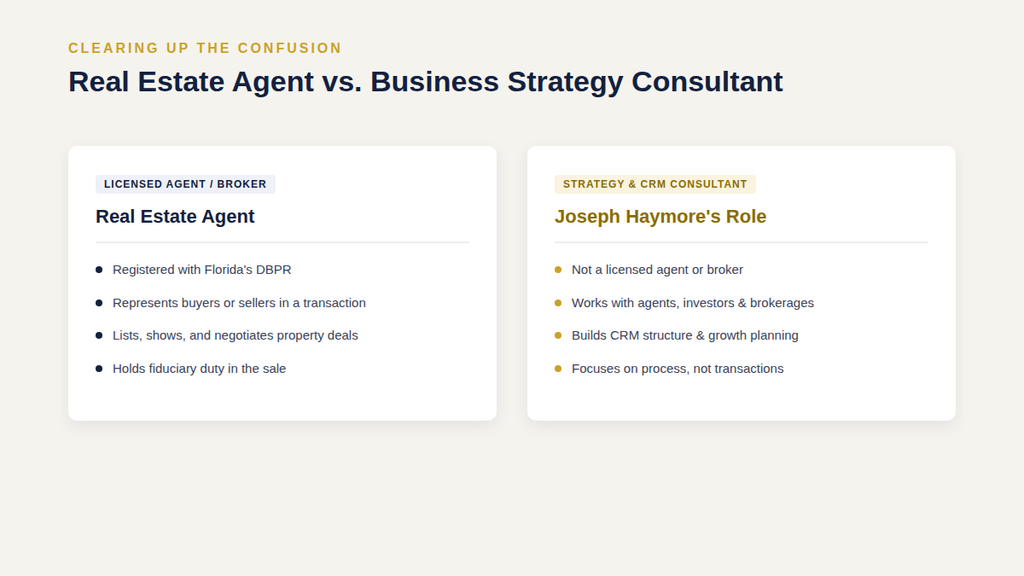
A licensed real estate agent or broker in Florida is registered with the Department of Business and Professional Regulation (DBPR) and is legally authorized to represent buyers or sellers in a transaction: listing property, showing homes, negotiating offers, and handling the contractual and fiduciary responsibilities that come with representing a client in a sale.
A real estate business strategist or CRM consultant operates in a different lane entirely. Instead of representing a party in a transaction, this role works with people who are already active in real estate, agents, brokerages, or investors, on the infrastructure behind their business: how they track relationships, how they decide which leads to prioritize, and how they measure whether their process is actually working.
Joseph Haymore’s work falls into the second category. He does not list, show, negotiate, or close property transactions on behalf of clients. His services are structural: market research, product and service analysis, CRM system design, and business development planning for people already working in or adjacent to real estate.
Why CRM and structured planning matter in real estate
Real estate businesses, whether run by individual investors, agents, or small brokerages, tend to generate a high volume of unstructured relationships. A single active agent might field dozens of inquiries a month across multiple channels: referrals, open houses, online forms, cold outreach. Without a system, most of that volume becomes noise. Leads go cold because no one remembers to follow up. Referrals get informally tracked in a notebook or a memory that eventually fails. Follow-up timing becomes a matter of whoever happens to think of it that day, rather than a deliberate cadence.
A CRM system solves the mechanical half of that problem: it gives a business a record of who to contact, when, and why. But the mechanical half is only half the problem. The harder question is strategic: deciding what “good” follow-up actually looks like for a given business, which leads are worth the time investment, and how the definition of “worth prioritizing” should change as the business grows or the market shifts.
This is the gap that business strategy consulting in this space is generally positioned around: not selling CRM software itself, but helping a business figure out what it actually needs from one, and building the decision-making structure that determines how it gets used day to day.
4 Common CRM mistakes real estate businesses make
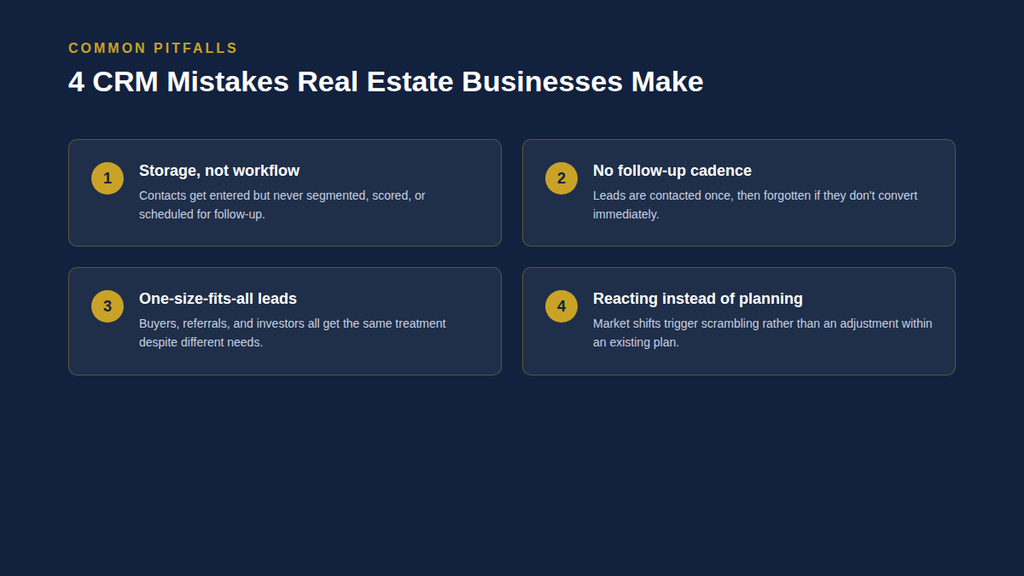
A few patterns show up repeatedly in real estate businesses that haven’t built a deliberate CRM strategy:
- Treating the CRM as storage instead of a workflow. Contacts get entered but never segmented, scored, or scheduled for follow-up, so the system becomes a filing cabinet rather than a tool that drives action.
- No defined follow-up cadence. Leads get contacted once, then forgotten if they don’t convert immediately, even though real estate decisions often take months.
- No distinction between lead types. A first-time buyer researching the market, a referral from a past client, and an investor scouting multiple properties all need different follow-up approaches. Treating them identically wastes time on the wrong leads and under-serves the right ones.
- Reacting to the market instead of planning around it. Without a structured plan, market shifts (rate changes, inventory swings, seasonal slowdowns) tend to produce reactive scrambling rather than an adjustment within an existing strategy.
Addressing these isn’t primarily a software problem, it’s a planning problem, which is the layer a business strategist typically works on rather than a CRM vendor.
Joseph Haymore’s three-stage approach
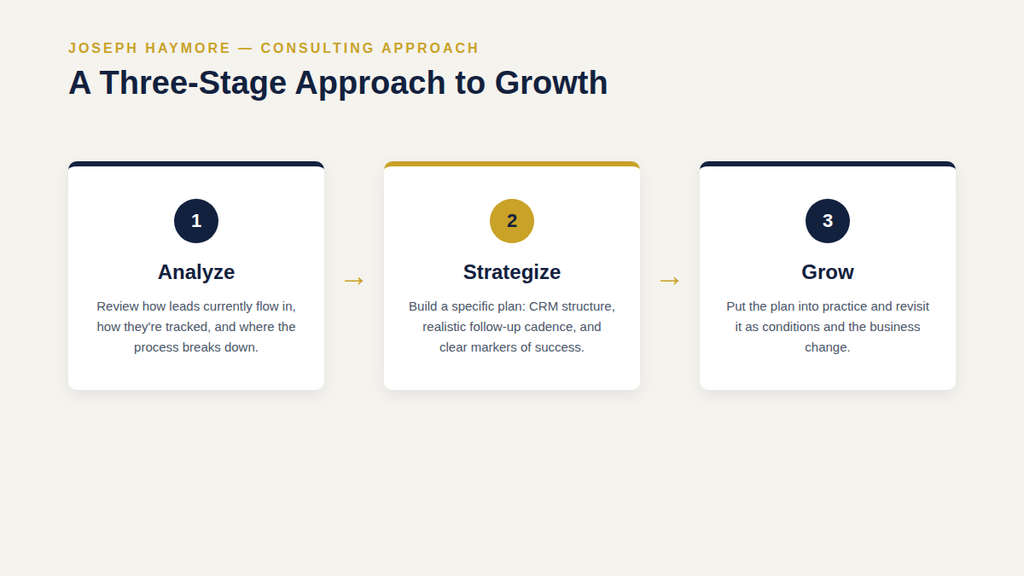
Analyze. The starting point is understanding the current state of a client’s business: how leads currently flow in, how they’re tracked (or aren’t), and where the process breaks down. This stage is diagnostic rather than prescriptive; the goal is an accurate picture before any changes are proposed.
Strategize. From that diagnosis, the next stage is building a specific plan: what the CRM structure should look like, what a realistic follow-up cadence is for that business’s volume and client type, and what markers indicate the plan is or isn’t working.
Grow. The final stage is execution and adjustment: putting the plan into practice and revisiting it as conditions change, rather than treating the initial plan as fixed.
What to expect when working with a real estate business strategist
Engagements in this space generally start with a conversation about the current state of the business: what’s working, what isn’t, and what the client is trying to achieve. From there, the work typically moves into a review of existing processes (if any), a proposed structure, and an implementation phase. The specifics of scope, timeline, and cost are worth confirming directly, since consulting engagements are usually scoped to the client’s situation rather than sold as a fixed package.
Client feedback
Joseph Haymore’s own site publishes feedback from a small number of named clients, describing the engagement in terms of clarity, reduced stress in decision-making, and step-by-step guidance that helped them avoid costly missteps. That feedback is self-published rather than independently verified, and readers evaluating any consultant, in real estate or otherwise, should weigh testimonials on a business’s own site accordingly, alongside independent reviews where available.
Frequently Asked Questions
Is Joseph Haymore a licensed real estate agent or broker in Florida?
No. Joseph Haymore operates as a business strategy and CRM consultant. He does not hold a DBPR real estate license and does not represent buyers or sellers in property transactions.
Where is Joseph Haymore based?
Joseph Haymore, Florida, works out of Miami (2390 NW 2nd Ave, Miami, FL 33127).
What services does Joseph Haymore offer?
Market research, product and service analysis, CRM strategy, and structured business development planning for real estate professionals and investors.
Who does he typically work with?
People already active in real estate, agents, small brokerages, or investors, who want a more structured approach to tracking leads and planning growth, rather than someone looking for representation in buying or selling a specific property.
How long has Joseph Haymore been consulting?
His site states close to a decade of experience helping clients analyze their business processes.
How is a CRM strategy consultant different from CRM software?
CRM software is the tool that stores and organizes contact data. A CRM strategy consultant helps decide how that tool should be configured and used, segmentation, follow-up cadence, and prioritization, based on the specifics of a given business.
How can someone contact Joseph Haymore?
By phone at +1 (305) 677-3952, Monday–Friday, 9am–7pm EST.
1 Comment
[…] areas of Florida does Joseph Haymore work […]